The BBC on 15th March 2010 at 10:35pm has a documentary entitled "Diet or My Husband Dies".
It sounds like one of those strange "human interest" stories you read in those real-life story magazines.
But...
Andy Lamb was dying of kidney failure, he'd had a transplant before. He now has dialysis three times a week. His wife Samantha could save him by donating one of her kidneys. But she was overweight and had to loose 22kg (almost 50lbs) before the doctors would consider operating on her. She gave herself four months to loose the weight - 2kg a week. For the ladies, that's from a UK size 24 to a size 16.
As well as following her trying to shed so much weight, it includes part of Andy's treatment being filmed.
We also get treated to watching her kidney being removed, and then part of the transplant. Andy now has FOUR kidneys - his original two, still in the usual place, plus the first one transplanted and then his wife's, both in the front of his pelvic region. Most interesting part I found was just how quickly the new kidney sprung into action - as the surgeon completed the last stitches to join the blood supply to the new kidney, he said watch this, squeezed it and some blood-stained urine was expelled before he moved on to connecting it to the bladder.
If you have access to the BBC iPlayer and missed this, do have a look. (Yes, the transplant was a success.)
PS Samantha didn't use any magic diet pills, or special herbs, or special tea, or secret formula drink, she reduced her food intake and increased the amount of exercise she took.
Monday, 15 March 2010
Friday, 5 March 2010
Baxter recall faulty dialysis machines
We have read on several news sites today, including the FDA site that Baxter are urgently recalling a number of peritoneal dialysis machines manufactured by them. A full list of models affected is given on the FDA site, and on Baxter's press release section of their web site.
Obviously it is important that users of these machines check immediately the status of their machine, so we are reproducing the machine details here.
Affected model numbers are:
Home Choice - 5C4471, 5C4471R, 5C4474, 5C4474R, T5C4441, T5C4441R, 5C4474D, 5C4474DR
Home Choice Pro - 5C8310, 5C8310R, R5C8320, R5C8320R, T5C8300, T5C8300R
All systems with these model numbers are affected.
This is because of reports of serious injuries and at least one death associated with Increased Intraperitoneal Volume (IIPV), also known as overfill of the abdominal cavity. IIPV can cause serious breathing and heart problems that can result in serious injury or death.
Children and non-verbal patients may be at increased risk because of their smaller size or inability to communicate. Increased monitoring of these patients is recommended.
Other vulnerable populations include critically ill patients and patients with pulmonary and hemodynamic instability.
Public Contact: If you need assistance with your HomeChoice or HomeChoice PRO, call the Baxter Customer Service line, available 24 hours and day, 7 days a week at 1-800-553-6898.
We suggest you have a read of both the web pages linked to above, in case we have missed out anything vital in our summary of the press release.
Obviously it is important that users of these machines check immediately the status of their machine, so we are reproducing the machine details here.
Affected model numbers are:
Home Choice - 5C4471, 5C4471R, 5C4474, 5C4474R, T5C4441, T5C4441R, 5C4474D, 5C4474DR
Home Choice Pro - 5C8310, 5C8310R, R5C8320, R5C8320R, T5C8300, T5C8300R
All systems with these model numbers are affected.
This is because of reports of serious injuries and at least one death associated with Increased Intraperitoneal Volume (IIPV), also known as overfill of the abdominal cavity. IIPV can cause serious breathing and heart problems that can result in serious injury or death.
Children and non-verbal patients may be at increased risk because of their smaller size or inability to communicate. Increased monitoring of these patients is recommended.
Other vulnerable populations include critically ill patients and patients with pulmonary and hemodynamic instability.
Public Contact: If you need assistance with your HomeChoice or HomeChoice PRO, call the Baxter Customer Service line, available 24 hours and day, 7 days a week at 1-800-553-6898.
We suggest you have a read of both the web pages linked to above, in case we have missed out anything vital in our summary of the press release.

Thursday, 25 February 2010
News Release on Wearable Kidney Belt
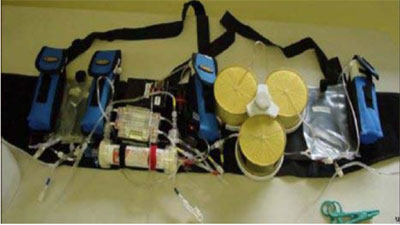
We came across this news release on a wearable kidney belt for portable use. We seem to come across these sort of news items regularly.
Here's an extract from the news at Kidney Org. Australia
Australasian Home Haemodialysis Workshop Brisbane 11-12 February 2010
Dr Carmel Hawley, Clinical Director of Haemodialysis, Princess Alexandra Hospital and Chairman of a major conference in Brisbane on home dialysis said the wearable kidney would be discussed at the conference. The filtration device is worn on a belt around the waist and weighs approximately five kilograms. There are four micro-pumps which are driven by standard batteries.
The belt is manufactured by Xcorporeal Inc (United States), and a presentation by them is available online. You can visit the Xcorporeal website as well. They list several papers they have presented on this topic from 2006 - 2008, but I didn't notice anything more recent.
Tuesday, 23 February 2010
Fresenius Dialysis Patient Champions - 2010
Fresenius Medical Care, the big dialysis services and products provider, has selected 31 patients (that's one for each day in March) who, it feels, have shown dedication, positive attitudes and / or provided inspiration to other CKD patients.
“During National Kidney Month, we are pleased to honor these 31 patients who demonstrate that people with CKD can lead well-rounded, fulfilling lives,” says Rice Powell, CEO of Fresenius Medical Care North America. “Many successful long-term dialysis patients are self-reliant people who have embraced their treatment program, and want to live as normal a life as possible.”
They plan to publish details about each patient on their web site, but at the present moment the champions pages are not on-line, not even a holding page. So no link to them yet. I might summarise a few of these patient reports here (but with 31 to choose from, it might take a while to decide who to talk about). Usually such stories describe personal achievements in overcoming problems, or how they continue with their work or hobbies just as before starting dialysis, and they can help those new to dialysis realise what they can do. Fresenius has a newsletter that often gives details about one or two CKD sufferers (who, just by coincidence, use their products), and I'd guess these champion stories will be in a similar format.
“During National Kidney Month, we are pleased to honor these 31 patients who demonstrate that people with CKD can lead well-rounded, fulfilling lives,” says Rice Powell, CEO of Fresenius Medical Care North America. “Many successful long-term dialysis patients are self-reliant people who have embraced their treatment program, and want to live as normal a life as possible.”
They plan to publish details about each patient on their web site, but at the present moment the champions pages are not on-line, not even a holding page. So no link to them yet. I might summarise a few of these patient reports here (but with 31 to choose from, it might take a while to decide who to talk about). Usually such stories describe personal achievements in overcoming problems, or how they continue with their work or hobbies just as before starting dialysis, and they can help those new to dialysis realise what they can do. Fresenius has a newsletter that often gives details about one or two CKD sufferers (who, just by coincidence, use their products), and I'd guess these champion stories will be in a similar format.
Friday, 5 February 2010
A successful transplant of an incompatible kidney

When you read about a transplant, you normally think "weren't they lucky to find a compatible donor". A post in January mentioned network transplants, showing the ingenuity sometimes required to get a compatible organ.
So it was a bit of a surprize to read in the Times Online today that a woman has had a transplant of an incompatible kidney. The operation was triggered when Maxine Bath developed serious blood pressure problems. The kidney, from her sister, was not compatible and she had been waiting for 15 years, hoping to get a transplant.
The technique used involved chilling samples of her blood, turning the proteins and anti-bodies into a gel, then filtering it to remove the antibodies (which would prevent a successful transplant by attacking the "foreign body"). Then the plasma is thawed out and can be returned to the body. Other antibody removal techniques would have lowered Ms Bath's blood pressure to dangerous levels. Five sessions of cryofiltration were required before the operation at University Hospital, Coventry, could be started.
Although tests had earlier shown no good match within her family circle, her sister Michelle was the closest match, and agreed to donate a kidney, as doctors thought Maxine only had months left to live.
This was said to be the first time this technique had been used for a kidney transplant. Apparently it will only slightly increase the number of renal failure patients who can have a transplant. But any increase is a bonus.
Subscribe to:
Posts (Atom)